By: Bram Schumer
Facebook CEO Mark Zuckerberg has big dreams, and even bigger expectations to meet. The social media company’s public offering earlier this year was given nearly as much coverage and excitement as the London Olympics, only to disappoint investors when its share price plummeted over the summer. But however cheap it is to buy Facebook stock these days, it’s official: the new guard of American industry lies at the fingertips of those in Silicon Valley.

Chicago Image

Wednesday, October 31, 2012

Tuesday, July 24, 2012
Microsoft’s New Tool Helps Nonprofits & Corporations Tell Stories of Social Impact
Microsoft’s new mapping tool is helping nonprofits and corporations utilize technology to effectively communicate stories of their impact on society. The Microsoft Local Impact Map is a customized map showcasing an organization’s work in local communities around the world. This new tool is unique as it incorporates text, pictures, videos and social media tools. It enables stories to be easily shared and promoted. Marnie Webb, co-CEO of Microsoft nonprofit partner TechSoup, states, “Before implementing the Local Impact Map, we had case studies in different formats, such as PDF files, Word documents and PowerPoint presentations, scattered all across the organization. It made me nuts. The Local Impact Map gave us the ability to put all these case studies into one place.” Corporations are able to use the tool as well. UnitedHealthcare has been using the map internally for their 80,000 employees to contribute stories of their volunteer work. The tool is intended to transform the way nonprofits and corporations use technology to promote their social impact within local and international communities.
To read more about how Microsoft is helping organizations communicate their stories, you can click here or here.
Wednesday, July 18, 2012
How To Get Senior Leaders to Transform
By: Gene Zlotnikov
Senior business leaders are hard-working, intelligent and believe they are doing the right thing at work. However, people may have a superfluous optimism about their own behavior and might think they are better than they are – a psychological phenomenon known as “self-serving bias.” If senior leaders are to embrace the fact that they must change some form of their behavior, a good strategy for change is a concrete 360-degree feedback technique, which measures the desired changes that will drive business performance. A strong example of this includes Amgen CEO Kevin Sharer’s approach of asking his top 75 staff what he could do differently and sharing his development needs publicly with his team. This circle of feedback can not only transform leaders, but could also create sustainable growth for the organization.
To learn about how to break “self-serving biases,” you can read the Harvard Business Review story here.Davidoff Communications - How To Get Senior Leaders to Transform
Senior business leaders are hard-working, intelligent and believe they are doing the right thing at work. However, people may have a superfluous optimism about their own behavior and might think they are better than they are – a psychological phenomenon known as “self-serving bias.” If senior leaders are to embrace the fact that they must change some form of their behavior, a good strategy for change is a concrete 360-degree feedback technique, which measures the desired changes that will drive business performance. A strong example of this includes Amgen CEO Kevin Sharer’s approach of asking his top 75 staff what he could do differently and sharing his development needs publicly with his team. This circle of feedback can not only transform leaders, but could also create sustainable growth for the organization.
To learn about how to break “self-serving biases,” you can read the Harvard Business Review story here.
Tuesday, April 3, 2012
“Human Hotspots” Create a Stir

In mid-March, South by Southwest (SXSW) Interactive hosted its five day conference on emerging technology. The event convenes top thought leaders in the industry to touch on “creative solutions for a better tomorrow.” Yet, the “solution” that grabbed all of the headlines didn’t spring from a keynote speech, a panel presentation or an interactive workshop. The big story this year came from the homeless individuals strolling throughout the event, selling Wi-Fi access. The backlash to news of these “human hotspots” was quick and widespread.
Tuesday, March 27, 2012
Three Simple Steps to Staying on Mission
True leadership requires the willingness to recognize the need for change, as well as the ability to lead and manage change. Companies that consistently choose to pursue change are typically growing, dynamic organizations that stick to their mission. On the other hand, companies that fear change are likely to find it more challenging to remain relevant and continue to meet their customers’ needs. Forbes contributor Mike Myatt, describes three easy steps to help leaders and organizations stay on mission by leading change:
• Identify the Need for Change
If your organization is not willing to innovate to meet society’s changing demands, it is more likely to struggle and fail. To stay relevant and successful, companies should focus on changes that will help them more effectively serve their customers (and potential customers) and shift their corporate culture to foster an efficient and positive workforce.
• Lead Change
When faced with change, people typically respond by taking on one of four roles, becoming the Victim, the Neutral Bystander, the Critic or the Advocate. To successfully lead change, these four roles must be communicated to using appropriate messaging and properly involved in the process.
• Manage Change
Successful change leaders will ensure that their company is aligned with the same mission and vision for change, provide their employees with responsibility and accountability for innovation and maintain authority over change to ensure things happen.
To learn more about how to stick to mission and lead change in your organization, read the original article in Forbes.
For more information about how you can take your leadership to the next level, check out this upcoming event on Transformational Leadership, April 27th and 28th, 2012 in Chicago: Transformational Leadership Awards Dinner & Symposium
Tuesday, March 20, 2012
Panera: The Nonprofit

Imagine a restaurant where food prices are only a mere suggestion. The man in front of you pays an extra dollar for his smokehouse turkey panini. You round up to the nearest dollar for your Asian sesame chicken salad. The woman behind you pays what she can, a dollar and some loose change for her broccoli cheddar soup.
Is this a utopian ideal of a concept, unrealistic and bound to fail? No. It is Panera Cares, a community café launched in St. Louis in May 2010. The concept is simple: customers pay what they can, offering more than the suggested price if they’d like or enjoying a free meal if finances are tight. Cashiers don’t take any money, they only make change. The customers themselves deposit their donation into a locked glass box.
Ron Shaich, the president of the Panera Bread Foundation, said, "Twenty percent of customers pay more than the suggested donation. Sixty percent leave the suggested donation and 20 percent leave less, typically significantly less."1
The cafés are an inventive approach to feeding the hungry. The idea was based off of the SAME Café, which opened in Denver in 2006, but putting the power of Panera behind it offers grander possibilities of impact and influence.
Since the pilot restaurant, Panera has opened two more locations in Dearborn, MI and Portland, OR. On February 23, 2012, Panera announced they would be finalizing the locations for at least two more of the cafés by spring.2
Sources
1 ABC News 2 MSN Money
Tuesday, March 13, 2012
Soccer + Portable Energy = sOccket

Two Harvard graduates, who are only 23 years old, are already the heads of their own business. Not only is their product doing well in the world, but it has also received top praise from a former president.
The two women you may be in awe of are Jessica Matthews and Julia Silverman, the founders of Uncharted Play. Matthews and Silverman created the sOccket, a soccer ball that harnesses the kinetic energy of a game and turns it into post-game electricity. Donated balls have already been distributed in Mexico, El Salvador, Costa Rica, Haiti and Nigeria.
Uncharted Play has one goal: convince the masses to reTHINK FUNction. By combining innovation with a dedication to fun, Matthews and Silverman have created a genius (and simple!) product to provide portable energy to resource-poor communities.
After just 30 minutes of play, the sOccket can power 3 hours of LED light. This allows resource-poor families to save money they would normally spend on kerosene, fumes of which can be fatal. The sOccket can also provide electricity for water purifiers, mini-fridges and emergency cell phone chargers.
Silverman is already looking forward to what lies next on the horizon for Uncharted Play. Silverman explained that Uncharted Play’s mission is “about dreaming and thinking about your community and how you can better it through innovation.”
To read more about how the sOccket is helping families have fun while saving money, read the CNN article about powerful women entrepreneurs here or visit the official website.
Wednesday, March 7, 2012
Facebook's Next Innovation on Its Mission
 By: Gene Zlotnikov
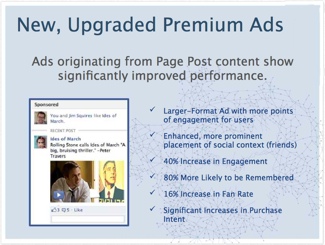
Facebook is about to put a completely new spin on online marketing and advertising. The social media giant is getting ready to launch a new format for premium ads that mark radical departure from traditional advertising. The new format is social by nature, pulling content from users’ posts to brands’ Facebook pages instead of from ad copy, and automatically showing you which of your friends already “like” the brand. Their statement is loud and clear: “ads based on content, rather than messaging, have a better chance of hitting home and ads involving tacit endorsements from the people you know have a better chance of capturing your attention.”
This new form of content-based advertising reinforces Facebook’s mission to “give people the power to share” and create opportunities for them to engage and connect online. Such a bold departure from traditional advertising is also very much in line with the company’s reputation for innovating the social media space. Facebook announced their planned changes at their marketing launch event at the end of February.
To read more about Facebook’s content-based ads, read the article in Fast Company.
Wednesday, February 29, 2012
Democracy in Action
By: John Davidoff
I walked the halls of Congress yesterday (2/28/12). Literally. I participated in the Museum Advocacy Day sponsored by our client, the American Association of Museums (http://www.aam-us.org/). About 300 museum professionals from all over the US spent all day Monday 2/27/12 going through a fantastic training at the Georgetown University Conference Center. On Tuesday 2/28/12 we arrived at Capitol Hill at 8am for a full day of lobbying for support of the our country’s 18,000 museums. I, personally, had face-to-face meetings with three Congress men (Danny Davis, Jan Schakowsky and Bob Dold) plus four other meetings with staff from Senators Durbin and Kirk’s offices and Congressmen Quigley and Jesse Jackson Jr.’s offices. I had never done anything like this before. I am amazed at how truly accessible our elected federal government representatives are to the voters of the United States of America. This was a fantastic experience and I am planning to be back next year for Museum Advocacy Day 2013.
*John Davidoff (left) visits with Illinois Congressman Bob Dold (center) and Kohl Children's Museum CEO Sheridan Turner (right) in the US Capitol Rotunda during Museum Advocacy Day on Tuesday, February 28.
I walked the halls of Congress yesterday (2/28/12). Literally. I participated in the Museum Advocacy Day sponsored by our client, the American Association of Museums (http://www.aam-us.org/). About 300 museum professionals from all over the US spent all day Monday 2/27/12 going through a fantastic training at the Georgetown University Conference Center. On Tuesday 2/28/12 we arrived at Capitol Hill at 8am for a full day of lobbying for support of the our country’s 18,000 museums. I, personally, had face-to-face meetings with three Congress
 men (Danny Davis, Jan Schakowsky and Bob Dold) plus four other meetings with staff from Senators Durbin and Kirk’s offices and Congressmen Quigley and Jesse Jackson Jr.’s offices. I had never done anything like this before. I am amazed at how truly accessible our elected federal government representatives are to the voters of the United States of America. This was a fantastic experience and I am planning to be back next year for Museum Advocacy Day 2013.
*John Davidoff (left) visits with Illinois Congressman Bob Dold (center) and Kohl Children's Museum CEO Sheridan Turner (right) in the US Capitol Rotunda during Museum Advocacy Day on Tuesday, February 28.
Friday, February 24, 2012
A Lesson in Marketing Brilliance: Method Laundry Crowdsources for Commercial
By: Stephen Delaney
In today’s marketing climate, innovative companies realize that marketing is no longer a one-way street. Instead, companies are increasingly engaging in an open dialogue with their consumers. When their company was faced with massive marketing challenges, Method Laundry decided to include their consumers in the conversation. Eric Ryan, co-founder of Method, says, “As a mission-driven brand, we have great consumer advocates.”
Those advocates stepped up to the challenge, allowing Method to produce a commercial via crowdsourcing. Consumers submitted clips of “themselves performing specific actions from a storyboard,” which were edited into one commercial. The week that the commercial debuted, it was the 93rd most viewed video on YouTube. It helped launch Method’s Facebook page, increasing their fans by 68 percent.
By running a company entirely aligned behind their mission, including their marketing efforts, Method cultivated a loyal consumer base. When Method turned to their consumers for help, those consumers jumped at the opportunity to support a respected, mission-driven business.
Watch the "Laundry Room Love" video below.
In today’s marketing climate, innovative companies realize that marketing is no longer a one-way street. Instead, companies are increasingly engaging in an open dialogue with their consumers. When their company was faced with massive marketing challenges, Method Laundry decided to include their consumers in the conversation. Eric Ryan, co-founder of Method, says, “As a mission-driven brand, we have great consumer advocates.”
Those advocates stepped up to the challenge, allowing Method to produce a commercial via crowdsourcing. Consumers submitted clips of “themselves performing specific actions from a storyboard,” which were edited into one commercial. The week that the commercial debuted, it was the 93rd most viewed video on YouTube. It helped launch Method’s Facebook page, increasing their fans by 68 percent.
By running a company entirely aligned behind their mission, including their marketing efforts, Method cultivated a loyal consumer base. When Method turned to their consumers for help, those consumers jumped at the opportunity to support a respected, mission-driven business.
Watch the "Laundry Room Love" video below.
Source: Entrepreneur.com
Friday, February 17, 2012
Dwight Eisenhower: Mission Driver
By: Stephen Delaney
President Eisenhower had a mission: defeating the Nazis. FedEx has a mission: delivering to any destination and as quickly as possible. It may seem silly to juxtapose the two, a world war and a commitment to rapid shipping. Yet in a post on Forbes titled “The Secret to Success? Stick to Your Mission,” Geoff Lotus, author of "LEAD LIKE IKE: Ten Business Strategies from the CEO of D-Day," draws parallels between the two.
To Lotus, success is achieved by ensuring that planning and operations, logistics and communications (specifically marketing) are all aligned behind mission. He views Eisenhower from a business perspective, examining how he kept all of those processes focused on mission. To illustrate, he names FDR and Churchill as Eisenhower’s bosses and the citizens of the United States, England and Canada as the majority shareholders.
Lotus’ message is simple: no matter the size of the challenge, the most important key to success is to stay on mission. Whether a president conducting an international war or a CEO directing his corporation, remaining mission-driven is the principal concern.
President Eisenhower had a mission: defeating the Nazis. FedEx has a mission: delivering to any destination and as quickly as possible. It may seem silly to juxtapose the two, a world war and a commitment to rapid shipping. Yet in a post on Forbes titled “The Secret to Success? Stick to Your Mission,” Geoff Lotus, author of "LEAD LIKE IKE: Ten Business Strategies from the CEO of D-Day," draws parallels between the two.
To Lotus, success is achieved by ensuring that planning and operations, logistics and communications (specifically marketing) are all aligned behind mission. He views Eisenhower from a business perspective, examining how he kept all of those processes focused on mission. To illustrate, he names FDR and Churchill as Eisenhower’s bosses and the citizens of the United States, England and Canada as the majority shareholders.
Lotus’ message is simple: no matter the size of the challenge, the most important key to success is to stay on mission. Whether a president conducting an international war or a CEO directing his corporation, remaining mission-driven is the principal concern.
Friday, February 10, 2012
The Utility of Corporate Volunteering
By: Stephen Delaney
In today’s economic climate, nonprofits are seeing an increased trend in corporate volunteerism. A recent article on Fast Company argues that corporations can provide more meaningful support if they lend their “manpower and expertise.” The author argues that financial contributions are not the best use of a corporation’s resources. Certainly, nonprofits can benefit from free training and other pro bono services a corporation could provide. Yet, it’s important to note that this article was written from a corporation’s perspective by Ali Marano, Vice President of Technology for Social Good at JPMorgan Chase.
Do nonprofits agree? Is corporate volunteerism an adequate substitute for dollars? Corporations may crave the PR they can whip up by saying they are taking an active role and accomplishing a concrete task for a nonprofit. Yet, what about the nonprofit’s ever-present financial demands for the less glamorous costs of administration and general operations?
Marano’s counter to this question is that organizations can redirect funds allocated for whatever project the corporation helps with and “invest them in other areas to directly meet their missions.”
What do you think?
For more information on corporate volunteering, you can see the story on Fast Company.
In today’s economic climate, nonprofits are seeing an increased trend in corporate volunteerism. A recent article on Fast Company argues that corporations can provide more meaningful support if they lend their “manpower and expertise.” The author argues that financial contributions are not the best use of a corporation’s resources. Certainly, nonprofits can benefit from free training and other pro bono services a corporation could provide. Yet, it’s important to note that this article was written from a corporation’s perspective by Ali Marano, Vice President of Technology for Social Good at JPMorgan Chase.
Do nonprofits agree? Is corporate volunteerism an adequate substitute for dollars? Corporations may crave the PR they can whip up by saying they are taking an active role and accomplishing a concrete task for a nonprofit. Yet, what about the nonprofit’s ever-present financial demands for the less glamorous costs of administration and general operations?
Marano’s counter to this question is that organizations can redirect funds allocated for whatever project the corporation helps with and “invest them in other areas to directly meet their missions.”
What do you think?
For more information on corporate volunteering, you can see the story on Fast Company.
Friday, February 3, 2012
The State of Corporate Philanthropy: How Non-Profits Can Make the Most of Their Current Situation
By: Gene Zlotnikov
At a recent Philanthropy Club meeting I had the chance to hear Kassie Davis, Executive Director of CME Group Foundation in Chicago, speak about corporate philanthropy. Ms. Davis shared her perspective on what non-profits should keep in mind as they reach out to corporate and foundation grant makers.
• Non-profits must be fully aware of what their mission is and be able to properly express their goals to grant makers.
• Do not reach out blindly to companies – do your research. Most corporate foundations have a website in which they clearly state how much money they give and exactly what they support.
• If there is no website or information to determine these specifics, non-profit executives should take initiative in reaching out to the appropriate person within the foundation to see if there is alignment for a partnership.
• The challenge facing grant-seekers is the constant struggle to get a foundation or corporation to listen to their message, let alone provide them with a grant.
Here is the good news: Ms. Davis says that although non-profits have seen funding shrink during the last few years because of the recession, corporate giving has been on the rise since 2010. Non-profits should be on the lookout for organizations that are passionate about the programs they are initiating. They must realize that they are unique and be able to effectively communicate their mission and vision to differentiate themselves from other organizations applying for grants.
To see what the CME Group Foundation supports please visit: http://www.cmegroupfoundation.org/
At a recent Philanthropy Club meeting I had the chance to hear Kassie Davis, Executive Director of CME Group Foundation in Chicago, speak about corporate philanthropy. Ms. Davis shared her perspective on what non-profits should keep in mind as they reach out to corporate and foundation grant makers.
• Non-profits must be fully aware of what their mission is and be able to properly express their goals to grant makers.
• Do not reach out blindly to companies – do your research. Most corporate foundations have a website in which they clearly state how much money they give and exactly what they support.
• If there is no website or information to determine these specifics, non-profit executives should take initiative in reaching out to the appropriate person within the foundation to see if there is alignment for a partnership.
• The challenge facing grant-seekers is the constant struggle to get a foundation or corporation to listen to their message, let alone provide them with a grant.
Here is the good news: Ms. Davis says that although non-profits have seen funding shrink during the last few years because of the recession, corporate giving has been on the rise since 2010. Non-profits should be on the lookout for organizations that are passionate about the programs they are initiating. They must realize that they are unique and be able to effectively communicate their mission and vision to differentiate themselves from other organizations applying for grants.
To see what the CME Group Foundation supports please visit: http://www.cmegroupfoundation.org/
Wednesday, January 25, 2012
Is Social Innovation Really Here to Stay?
 By: Gene Zlotnikov
In a January 12th Forbes article titled, Social Innovation: Is it Really Here to Stay? Shannon Schuyler discusses how major companies have created social innovation positions within their ranks in order to provide future sustainability for their organization. As companies innovate and transform, building strong corporate & non-profit partnerships will become an essential part of their growth and sustainability. The most important change organizations will need to understand is that corporate giving and philanthropy should not be as cut and dry as handing out checks anymore; rather, companies must be willing to approach social problems by sharing thoughts with one another in order to leverage truly powerful ideas that will lead toward organizational transformation.
Schuyler highlights one specific example of a company using their resources and social ability to innovate and fulfill their mission. Goldman Sachs’ 10,000 Women Campaign, which is trying to provide widespread business education to underserved women, is pairing Goldman’s business expertise and financial resources with 80 academic and nonprofit partners to scale meaningful change and, eventually, success. They are acting upon the philosophy that strong partnerships are a way that will lead organizations to become their most potent selves as they strive to carry out their vision and mission.
For more information about Social Innovation you can read the original Forbes article here.
Friday, August 12, 2011
Help Your Organization Live Happily Ever After
By: Jenny Barish
Once upon a time, in a faraway land, there was a non-profit organization that was in need of help. Although the organization’s leaders were passionate, and their cause was relevant, they faced great challenges, like developing new revenue streams, implementing a new marketing plan, and facing fire-breathing dragons. The economy was troubled, and the villagers showed little interest in their services. After dozens of presentations in front of board members, CEOs, and fairy godmothers, the non-profit organization had lost all hope and had no one to turn to for help…
Intrigued? Classic story frames such as these have stood the test of time. And there’s a reason for “Once upon a time’s” longevity. People love stories: they usually have relatable characters, vivid settings, clear themes, natural plot progressions, and a unique voice. And according to Pon Angara, principal at Barkada Creative LLC, a Chicago-based visual branding business, these characteristics are not limited to fairy tales.
In Angara’s recent presentation at the Chicago Philanthropy Club, I was brought back to my kindergarten story time circle, and was happy to learn that the basic principles of storytelling can be applied to the marketing, development, and strategic vision of an organization. As consultants at Davidoff Communications, we are dedicated to the most effective articulation of our clients’ goals, mission, and impact. The associations, non-profits, and corporate clients we work with each have a story to tell, and we engage in this artistic medium of communication to help each tell their own in the most compelling way possible.
With thousands of people trying to sell a new product, a brilliant social innovation, or a service, many organizations can get lost in the clutter. Using the classic components of storytelling to talk about your organization may forge a more personal or relatable bond with an audience. And according to Pon Angara, the best way to tell a story is through the “transformative power of the arts.” In Angara’s Philanthropy Club presentation, we closed our eyes and listened to music, and realized that a song has a powerful story to tell including all the essential elements. This idea was demonstrated through other mediums such theatre, art, and audiovisuals—engaging all human senses, connecting with people, and hopefully building rapport and support.
But how are all of these abstract ideas directly applicable to your organization? Strategically choosing music can communicate the mission or culture of a company at an office or at an event, a striking photo can say a lot in few words for an advertising campaign, and a video can bring an abstract idea, theme, or statement to life (Angara used this as an excellent example of theatrical storytelling).
As an avid lover of art, music, and culture, I think this concept is incredibly effective. As a learner, it’s hard to become passionate about the content in a flat PowerPoint presentation. But when I see the concepts illuminated through a painting, in a play, or with a song, I think longer and more deeply about the ideas presented. And as a consumer, I connect to the catchy melodies that I hear on the newest Apple commercial. It’s not necessarily the product that I fall so deeply in love with—it’s the story they are conveying through song, images, and characters. I can relate to the sounds, and I want not only to have the product or service, but to be a part of that company’s story.
Mr. Angara perfectly wrapped up his workshop with a quote from Maya Angelou,
Wednesday, July 27, 2011
Reviewing Your Social Media
 By: Elyssa Cherney
Both play a crucial role in forging your online reputation.
Although I am one of those savvy youths responsible for this digital explosion, and consider myself Facebook and Twitter literate, I still have trouble grasping exactly what social media means and what strategies should be used to support it.
So when I attended a technology lecture at the Chicagoland Chamber of Commerce called “Is Social Media Making Your Business Anti-Social???” I expected to learn about muploads (that’s mobile uploads) and retweeting. However, what keynote speaker Steven Dimmitt spoke about shattered the strict borders I had imposed on the social media world.
As the CEO of abSRDdity, an online reputation management service, Dimmitt shared his insights about the shifting relationship between advertising and the current world.
Technological, economic, and psychological factors are all redrawing the lines in conventional marketing. What used to be a one-way dialogue, controlled by the business, has now morphed into a two-way communication that gives the consumer more power.
Because there are more options for just about everything today, the consumer controls more of this process. He chooses how to search or find businesses and, because of this, he doesn’t have to settle for anything less than a deal.
This has forced the business model to change, with an increased focus on engaging the consumer. Social media is one of the ways businesses can reach out to potential audiences and hold their attention.
So you’ve got your Facebook page, your Twitter, a LinkedIN profile, and maybe even a blog. With all those platforms, your SEO must be climbing the ranks. It should be that much closer to making it on the first page of a search.
But here’s the kicker: though you are creating all that content, 80 percent of search results are user-generated. Instead of exposing potential clients to the material you chose, they are seeing what others have written about you in reviews, blogs, and other posts.
And they’re listening.
About 84 percent of users say that consumer reviews influenced their purchasing.
The online review, a sector that completely escaped my thoughts before hearing from Dimmitt, is another huge component of your online identity.
Most business have a Google Place Page, a Yelp site, a Bing listing, or a City Search review where customers post their feelings about companies
Consumers are more likely to post their thoughts after an unpleasant experience, denouncing the business and the service in a public rant.
Dimmitt pointed out that one bad review can cost you up to 30 potential customers. For damage control, he recommends five good testimonials for every negative one.
But when you do your job correctly, and a person has a positive experience, they probably won’t feel as compelled to gush about you online. The challenge is getting them to do just that, though it might not be as hard as you thought.
Just ask. If you see a consumer who is satisfied, invite them to write a review in person and e-mail them the link to your review site. It’s that easy.
Don’t let social laziness cost you customers.
Dimmitt offered three steps to building the online brand of your dreams—Assess, repair, maintain.
Claim online venues, respond to current dialogue and be diligent about getting positive reviews.
Do not ignore negative reviews. If there is a bad post, digest it, respond, and e–mail your employees about what went wrong. Contact the author of the review, inquire about their experience, and personally apologize.
If there is a positive review, share it over your social media and propel it to reach as many people as possible.
While I admit I still don’t understand the inner workings of social media, I know enough to realize it can be one of the most powerful business tools of today.
If you don’t get it, hire someone who does. Dimmitt suggests assigning a full time role as social media manager to one of your employees.
At Davidoff Communications, we too are realizing the power of the online world and using our summer interns (that’s me!) to refresh and update our own social media efforts. Writing frequent blogs, such as this one, is one component of this much larger project, but we also have one intern manning our online board and getting our name out there through Twitter and Facebook.
And if that wasn’t enough, now we know to monitor our online reviews too.
Wednesday, July 13, 2011
Branding Basics: Go for the Tough Stuff
By: Elyssa Cherney
The Bloomingdale’s signature “brown bag” is tightly clasped. Ray-Ban sunglasses coolly rest upon the heads of these eager shoppers who are fearlessly guided by a pair of Nike sneakers.
Yes, a stroll around my local mall reveals all things typical of an upper-middle class shopping center. From head to toe, these patrons flaunt their designer labels.
But in this brand-eat-brand world, we needn’t travel outside our own homes to witness this phenomenon.
By simply gazing in a mirror, we can see the brand we invest in the most: ourselves.
As I sat in on an internal marketing meeting at Davidoff Communications, I realized that the idea of branding penetrates much further than surface level impressions, and delves into deeply rooted ontological questions—ones that lie at the cornerstone of our identity.
How we brand ourselves—the image we project to the world based on the clothing we wear, the phrases we say, and attitudes we adopt—creates a defining label of who we are as humans.
It comes down to several critical questions that we all must ask ourselves—Who do I want to be? How do I want others to perceive me? What are the types of things that I want associated with my name?
While this introspective process happens acutely on a personal level, it occurs even more furiously on a larger-scale, within the business sector.
The impact of branding is reflected by the exorbitant amount of money that corporations are willing to invest in marketing.
According to TheList.com, the internet’s largest relational database of marketing and advertising decision makers in North America, major companies like General Motors and AT&T spend over two billion dollars on advertisements to build their respective images.
Traditionally, businesses are advised to consider several factors when deciding which resources should be allocated to marketing. Some businesses set a flat dollar rate, others calculate a sales-revenue ratio, and many follow the plans of their competitors.
Still, some maintain that there should be no monetary cap on marketing.
“For startups and small businesses, branding can often take a backseat to other considerations, such as funding and product development,” reads a 2009 column from businessweek.com that appeared in The New York Times. “This is a mistake, as a company's brand can be key to its success. Dollar for dollar, it is as important and vital as any other early steps.”
But the marketing landscape is forever changing. First came the Internet and now it’s the dawn of the social media era.
More than half of businesses with marketing budgets under $1000 are adopting social media practices rooted in Facebook, LinkedIn, and Twitter (in that order), reported a 2010 GrowBiz Media study called entitled “SMB Marketing Practices: Small to Midsized Business Survey Results, 2010.” The same report, which surveyed 751 small businesses of less than 1,000 employees from across the country, also found that nearly 40 percent of respondents are spending more than one fifth of their marketing budgets on websites.
In these tumultuous times, constantly being redrawn by technology, the effort to define the face of your business becomes increasingly difficult.
But there is one overarching constant: revisiting those tough questions. The challenge is to apply this process of self-questioning to our businesses.
The daily struggles and often-agonizing truths we must confront about ourselves act as a model for branding a company, a service, or a product.
We must maintain the same self-awareness and objectivity that serve as personal checks to evaluate the image our business presents to the rest of humanity.
Stagnancy is failure. If we simply accept our faults and do not try to change them, we will not build our moral and social character. Likewise, building a brand requires constant recalibration.
Change is not a sign of weakness; it is a mark of strength. We must have the courage to recognize when a problem exists and the creativity to find the best possible solution.
It will take time, but by remaining cognizant of these fundamentals, your business can furnish its own unique brand—one that is differentiated from the sea of your competitors and highlights the specific talents that only you offer.
Only then will your vision for your business match what the rest of the world sees, its reflection staring squarely back at you from that mirror.
The Bloomingdale’s signature “brown bag” is tightly clasped. Ray-Ban sunglasses coolly rest upon the heads of these eager shoppers who are fearlessly guided by a pair of Nike sneakers.
Yes, a stroll around my local mall reveals all things typical of an upper-middle class shopping center. From head to toe, these patrons flaunt their designer labels.
But in this brand-eat-brand world, we needn’t travel outside our own homes to witness this phenomenon.
By simply gazing in a mirror, we can see the brand we invest in the most: ourselves.
As I sat in on an internal marketing meeting at Davidoff Communications, I realized that the idea of branding penetrates much further than surface level impressions, and delves into deeply rooted ontological questions—ones that lie at the cornerstone of our identity.
How we brand ourselves—the image we project to the world based on the clothing we wear, the phrases we say, and attitudes we adopt—creates a defining label of who we are as humans.
It comes down to several critical questions that we all must ask ourselves—Who do I want to be? How do I want others to perceive me? What are the types of things that I want associated with my name?
While this introspective process happens acutely on a personal level, it occurs even more furiously on a larger-scale, within the business sector.
The impact of branding is reflected by the exorbitant amount of money that corporations are willing to invest in marketing.
According to TheList.com, the internet’s largest relational database of marketing and advertising decision makers in North America, major companies like General Motors and AT&T spend over two billion dollars on advertisements to build their respective images.
Traditionally, businesses are advised to consider several factors when deciding which resources should be allocated to marketing. Some businesses set a flat dollar rate, others calculate a sales-revenue ratio, and many follow the plans of their competitors.
Still, some maintain that there should be no monetary cap on marketing.
“For startups and small businesses, branding can often take a backseat to other considerations, such as funding and product development,” reads a 2009 column from businessweek.com that appeared in The New York Times. “This is a mistake, as a company's brand can be key to its success. Dollar for dollar, it is as important and vital as any other early steps.”
But the marketing landscape is forever changing. First came the Internet and now it’s the dawn of the social media era.
More than half of businesses with marketing budgets under $1000 are adopting social media practices rooted in Facebook, LinkedIn, and Twitter (in that order), reported a 2010 GrowBiz Media study called entitled “SMB Marketing Practices: Small to Midsized Business Survey Results, 2010.” The same report, which surveyed 751 small businesses of less than 1,000 employees from across the country, also found that nearly 40 percent of respondents are spending more than one fifth of their marketing budgets on websites.
In these tumultuous times, constantly being redrawn by technology, the effort to define the face of your business becomes increasingly difficult.
But there is one overarching constant: revisiting those tough questions. The challenge is to apply this process of self-questioning to our businesses.
The daily struggles and often-agonizing truths we must confront about ourselves act as a model for branding a company, a service, or a product.
We must maintain the same self-awareness and objectivity that serve as personal checks to evaluate the image our business presents to the rest of humanity.
Stagnancy is failure. If we simply accept our faults and do not try to change them, we will not build our moral and social character. Likewise, building a brand requires constant recalibration.
Change is not a sign of weakness; it is a mark of strength. We must have the courage to recognize when a problem exists and the creativity to find the best possible solution.
It will take time, but by remaining cognizant of these fundamentals, your business can furnish its own unique brand—one that is differentiated from the sea of your competitors and highlights the specific talents that only you offer.
Only then will your vision for your business match what the rest of the world sees, its reflection staring squarely back at you from that mirror.
Tuesday, July 5, 2011
Discovering Mission-Driven Marketing
By: Jenny Barish
Marketing has always played an integral role in my life. As a youngster, I was always receptive to television ads, and I was easily swayed by commercials, begging my mother for the newest Princess Barbie (much to my mother’s dismay) or Tamagachi (remember those?). In high school, I took a sports marketing course and found that the concepts came naturally. And for the Chicago Metro History Fair my junior year of high school, I chose to further explore the world of marketing—persuading my all- female project -mates to research Bill Veeck, the infamous manger of the Chicago White Sox who revolutionized promotional glitz and glamour. We made it all the way to the national competition, and my affinity to the marketing industry grew even stronger. Marketing seemed to be my niche. I loved the innovation, excitement, and psychology of it all, and at the young age of 17, there was no question that this was my calling.
When it came time to pick a college, I found my place at Ithaca College, a midsize private institution in central New York with killer views and an even more killer communications program. But as I studied business theories and the strategic model of communication alongside women’s studies and environmental destruction, I came to a quarter-life existential crisis. This all sounds very typical— the whole adolescent-coming-to-an-end-of-childhood-moment-and wants to fight against the system type of thing. But it was a real conundrum, and the more I learned about economic imbalance and over-consumption, the more I started to question the whole field of marketing. Was I just feeding the beast? I didn’t want to sell people more products and help contribute to more environmental crises or create more media-influenced perceptions about economic worth or gender norms (whew, as you can see this was quite the aha moment). Were all my childhood aspirations completely false and misinformed?
After my panic passed, I sat down and did what I do best: Facebook stalking. I came across an Alumni Group for Ithaca College, and I found that someone had responded to a posting I had made months ago about wishing to pursue a summer internship. It was John Davidoff, and he directed me to his company’s website, a “mission-driven marketing” firm based in Chicago that specialized in strategic non-profit/corporate partnership, sales consulting, and integrated marketing. I had no idea that this even existed, and as I further researched Davidoff Communications I was not only educated about an entire new sector of the communication industry, but I was reassured that I could be in marketing and not be a part of everything I had grown to hate. As I continue my work at Davidoff, my faith in cause marketing is constantly reaffirmed. I have seen how our work positively impacts the non-profit clients that work so hard to make a difference, and my hunger to use my research, rhetoric, and strategic thinking for good has grown even stronger.
Tuesday, June 28, 2011
A Marketing Awakening
By: Elyssa Cherney
As a journalism major, I didn’t think I was cut out for the harsh world of marketing.
Journalists seek truth; marketing executives distort it. While journalists spur progressive change, the marketing industry is too caught up in the glitz and glamour of their 401ks to genuinely care about improving society.
Or so I thought before starting a summer internship with Davidoff Communications.
While I expected to do my share of filing, I didn’t count on having an experience that revolutionized my way of thinking. It took only one week to shatter my prior perceptions of the marketing industry and the way it fits into the world.
I was warmly welcomed on my first day at Davidoff Communications and immediately became part of the team. Instead of doing mindless tasks, I was entrusted with real work and I was counted on to deliver results.
It became clear that my coworkers would not just be cold faces I pass in the office—they were people who genuinely cared about me and would make an effort to be involved in my life both professionally and personally.
After I discovered that real human beings worked in marketing, I soon realized what they were working for.
While Davidoff Communications helps for-profit companies develop strategic plans and strengthen their brand, they also do a great deal of work with nonprofits. After attending a retreat with one of their nonprofit clients, I realized the colossal significance of firms like this.
By helping nonprofits reorganize and run more effectively as a whole, Davidoff Communications spreads the good these groups devote themselves to. In bettering the internal structure and external image of nonprofits, the firm betters the way that nonprofits communicate with and interact in our world.
In this sense, they play a crucial role in our society. They give back by helping these nonprofits give back more efficiently.
What I originally thought of as a self-serving industry turned out to be extremely selfless—devoting its resources to and aligning itself with important causes.
While I realize this reflection may seem like an overt advertisement for Davidoff Communications, I want to make it clear that publicity is not my intention here.
As a journalist we are taught to share stories and I think the story of Davidoff Communications is one worth telling. Over the next three months I hope to document my experience as an intern—one who was a complete outsider to marketing just a few days ago.
Along the way I hope to share my insights about the marketing industry, nonprofit work, and maybe some occasional complaints about filing. So, with all seriousness, fasten your seatbelts and prepare for the ride.
Tuesday, November 2, 2010
“The Shift” from Marketer to Growth Leader
I recently had the opportunity to hear Scott Davis, Senior Partner of the strategic brand and marketing consultancy, Prophet, speak about his new book “The Shift: The Transformation of Today’s Marketers into Tomorrow’s Growth Leaders.” During his speech Mr. Davis shared personal stories that underscored the powerful loyalty that can be inspired in people when a brand delivers well on its promise. He went on to dive into the core theme expressed in his book: marketing is more than discretionary spending to build awareness – it is a powerful tool to affect change and drive strategic objectives. Marketing, at its best, has the most to offer in support of growth agendas because it is closer to the customers and competition. For marketing to be effective, it must have a good understanding of its audience and who else is trying to reach that audience. Leveraging these insights in support of strategy is where marketing can prove its value as growth leader.
Mr. Davis went on to highlight the five key shifts marketers should strive to make in order to change their profile from marketer to Growth Leader driving Visionary Marketing.
The 5 Shifts:


Subscribe to:
Posts (Atom)